
Export-ready doesn't always mean market-ready for Europe
Why entering a new market takes more than a great product — and how understanding customers, defining positioning and building a coherent brand strategy can make the difference.

A great product is only the beginning
Chinese manufacturers are among the most experienced and competitive participants in global supply chains. They combine advanced technologies, extensive production capabilities and the ability to respond quickly to changing customer needs.
Many Chinese companies have successfully supplied European importers and retailers for decades. An increasing number are also developing their own brands for international markets.
Yet even world-class manufacturing capabilities do not automatically translate into readiness to compete in a new market.
A product can be exceptionally well designed and manufactured while still lacking a clearly defined place in the minds of its intended customers.
Consumers rarely see the manufacturing process or understand the full capabilities of the factory behind a product. They see its packaging, brand, price and the way it is presented. From these signals, they form an opinion about whether the product meets their needs and deserves their trust.
European importers and retail buyers take a broader view, but their considerations go beyond technical specifications and commercial terms. They also evaluate the product’s potential within a category, its positioning, competitive advantages and ability to communicate meaningful value to consumers.
Between manufacturing readiness and market readiness lies a distinct area that requires research, strategic decision-making and creative expertise.
This is what we refer to as European Market Readiness.
Europe is not one market
The European Union provides a single market, but this does not mean that European consumers share identical needs, purchasing habits or expectations of brands.
Individual countries differ in retail structures, price levels, competitive environments, distribution channels, category maturity and cultural contexts.
These differences are visible even in an area as fundamental as online shopping.
According to Eurostat, 78% of internet users in the European Union purchased goods or services online in 2025. In Ireland, the figure reached 95%, compared with 57% in Bulgaria.
These statistics do not tell us how to design a particular product or its packaging. They do, however, demonstrate why Europe should not be treated as one homogeneous market.
Even within a single country, the same product may require different communication depending on its sales channel.
A product sold through a specialist distributor will be evaluated in a different context from one offered in a hypermarket, discount retailer or online marketplace.
That is why the question “How do we prepare this product for Europe?” should begin with another: “Which specific market are we entering, who are we targeting and how do we intend to reach them?”
This goes far beyond choosing the language used on the packaging. It is the starting point for defining an effective market strategy.
When should market research come before strategy?
One of the most common challenges in entering a new market is insufficient knowledge of the intended audience.
Manufacturers understand their products and production capabilities in great detail. However, they may not have the same depth of knowledge about local consumer behaviour, competing brands or the structure of European retail.
A sound strategic process should therefore begin with an assessment of the information already available.
For some projects, desk research, competitive analysis, category reviews and an audit of existing brand communications may provide an adequate foundation.
In other cases, additional qualitative or quantitative research may be justified, including interviews with consumers, importers or retail buyers.
Research can help answer questions that directly influence strategic decisions:
- Which needs and problems matter most to our target customers?
- Which products and brands will consumers compare our offering with?
- How do they perceive different levels of price and quality?
- Which product features represent meaningful advantages, and which are less relevant to purchasing decisions?
- What information do customers need to make a confident purchase?
Not every company needs an extensive research programme.
What matters is understanding which decisions can be made using the knowledge already available and which require further validation.
At OUTBO Europe, we approach market analysis and research as tools that support strategy — not as a mandatory process of identical scope for every project.
Brand strategy: turning product features into customer value
Manufacturers describe their products through specifications: materials, functionality, technologies, durability and manufacturing quality.
Consumers ask different questions.
Will this product solve my problem? Is it convenient to use? Does it fit my lifestyle? Does its quality justify the price? Can I trust the brand behind it?
The role of brand strategy is to connect a product’s genuine capabilities with the needs, motivations and expectations of clearly defined audiences.
An effective strategy establishes who the offering is intended for, which alternatives it competes against, what benefits it promises and what evidence makes those promises credible.
Only then can we consciously define the brand’s positioning and identity.
A brand is not simply a name, a logo or a colour palette.
It also exists in the associations, emotions and experiences people have whenever they encounter it.
A brand designed to inspire confidence and reliability needs a different approach from one built around individuality and aspiration. A brand whose primary advantage is simplicity and affordability requires yet another approach.
These distinctions should not emerge solely from a designer’s aesthetic preferences. They should follow deliberate strategic decisions.
Naming: a brand name must work in the market, not just sound good
Choosing a name is one of the most important decisions in building a brand.
A name should express the chosen strategy, reinforce desired associations and help establish a distinctive position within a competitive environment.
International expansion introduces additional challenges.
A name that works well in China may not be equally easy for European audiences to pronounce, remember or understand. Some meanings and associations may be deeply rooted in the language and culture of the country of origin but carry little meaning elsewhere.
At the same time, creating an international brand name should involve more than simply adapting an existing Chinese name phonetically to the Latin alphabet.
Effective naming combines brand strategy, language and cultural relevance with the practical ability to protect the name as a trademark.
At EVG Group and OUTBO Europe, we develop names for brands, products and services as an integral part of the strategic process.
We evaluate potential names in terms of meaning, pronunciation, clarity, memorability and the associations they may create among target audiences.
In parallel, we conduct preliminary checks for potential conflicts with existing names and trademarks, as well as the prospects of obtaining appropriate legal protection in the intended markets.
This includes considering identical and similar trademarks, relevant classes of goods and services, and the geographical scope of the protection required.
We work with trademark attorneys and intellectual property lawyers specialising in trademark clearance, registration and protection.
Depending on the expansion strategy, this process may involve assessing the possibility of securing protection through the European Union Intellectual Property Office (EUIPO), relevant national trademark offices or appropriate international registration procedures.
Preliminary availability checks can reduce risk, but they cannot guarantee that a trademark will be accepted for registration. Legal specialists should therefore be involved before a new name is adopted and implemented at scale.
A brand name should be more than a creative idea. It should be a considered business decision that provides a sound foundation for long-term development and legal protection.
This approach helps reduce the risk of expensive changes to names, packaging and communication materials at later stages of a project.
Three strategies, one goal: how Chinese brands adapt to new markets
There is no single formula for bringing a Chinese brand into European markets.
Sometimes a new name and identity are needed. Sometimes repositioning an existing brand is the better solution. In other situations, a company may choose to develop a separate brand for a particular customer segment.
Three examples demonstrate how different the strategic responses to the same challenge can be.
Wanglaoji / WALOVI — when a new market calls for a new brand language
Wanglaoji (王老吉) is one of China’s historic herbal beverage brands. Its domestic identity is closely associated with traditional concepts of wellbeing, including the idea of internal heat familiar in Chinese culture.
For consumers in other markets, these associations are not necessarily as intuitive or meaningful.
When developing the international brand WALOVI, the company therefore faced a challenge that went far beyond translating its name or redesigning a beverage can.
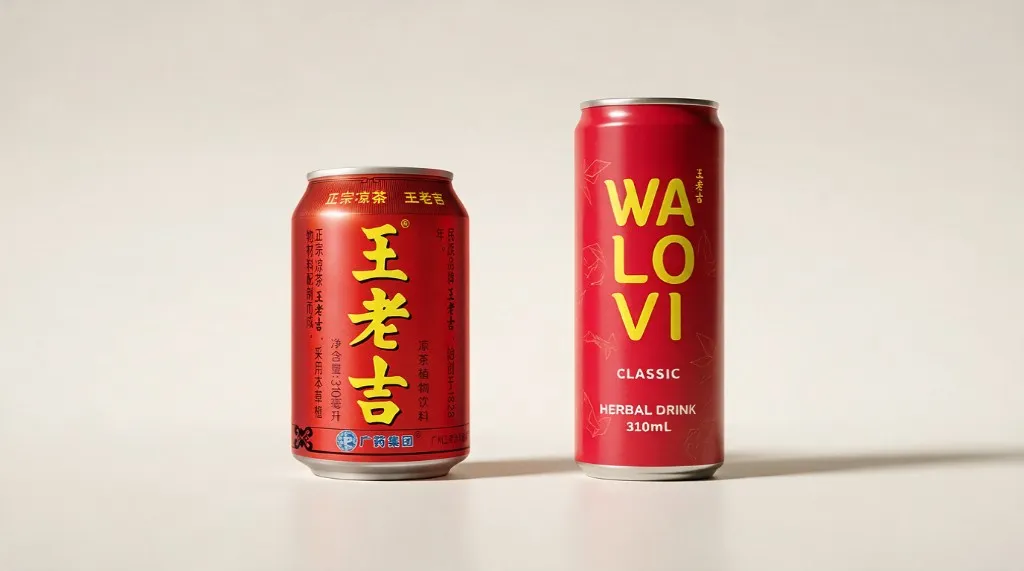
Working with the global branding consultancy Lippincott, it developed a new positioning expressed through the concept Undo the Overdone.
Rather than relying on a traditional idea that required cultural explanation, the brand began communicating a more universally recognisable need: restoring balance in today’s fast-paced world.
The project introduced a new name, visual identity and packaging architecture inspired by the product’s herbal ingredients.
The international identity retained references to the product’s Chinese origins while presenting them through a visual and verbal language designed for a broader global audience.
In 2025, a new series of international WALOVI packaging was presented, including in the German market.
However, the most significant aspect of this transformation was not the new name itself.
The essential strategic decision was to redefine how the product’s value should be communicated. The new name, visual identity and packaging followed from that decision.
Wanglaoji / WALOVI illustrates the difference between a simple visual adaptation and the strategic preparation of a brand for international expansion.
佰草集 / Herborist — when a brand finds a new positioning
Herborist (佰草集), a Chinese skincare brand owned by Shanghai Jahwa, developed its identity around the combination of traditional Chinese knowledge of botanical ingredients and contemporary skincare.
In 2008, the brand entered the French market through Sephora.
In China, Herborist had established a customer base that included the mid-market segment. In France, however, the brand was presented in a more prestigious context, with a premium positioning emphasising its Shanghai heritage and traditional botanical expertise.

An important part of this transformation involved developing the brand’s identity.
Working with the international branding agency centdegrés, Herborist developed its visual identity, packaging, product presentation and customer experience in retail environments.
This approach turned the brand’s Chinese heritage into a source of differentiation rather than a communication barrier.
Herborist was able to establish a more prestigious positioning in France than the one it occupied in its principal domestic segment.
In subsequent years, the brand expanded its distribution through European beauty retailers, including Sephora and Douglas. In 2015, it also opened its own boutique on Avenue de l’Opéra in Paris.
Herborist demonstrates that international expansion does not always require creating an entirely new brand. Sometimes greater value comes from recognising the potential of an existing identity and changing the context in which customers experience it.
Midea / Comfee — when one manufacturer builds different brands for different audiences
Chinese home appliance group Midea demonstrates another approach: multi-brand strategy.
Alongside its main Midea brand, the group has developed a portfolio of distinct home appliance brands. One of them is Comfee, which is also present in European markets.
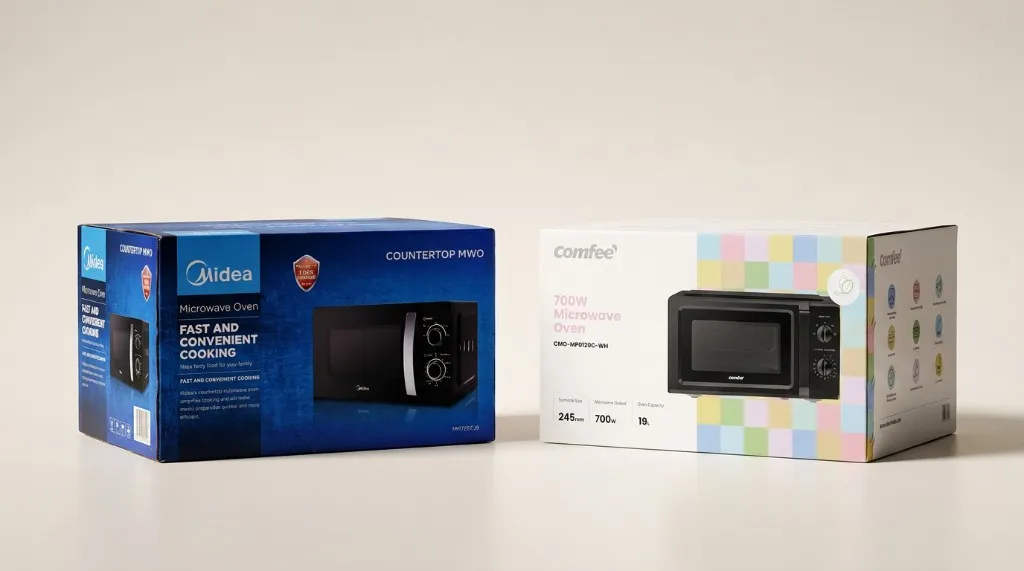
Comfee communicates through its own identity and value proposition, aimed particularly at younger international consumers.
Contemporary design, ease of use, everyday convenience and accessibility are central themes in its brand communication.
Comfee benefits from the technological and manufacturing capabilities of the Midea Group, but it does not need to communicate with consumers in exactly the same way as the parent brand.
This is not an example of Midea being renamed Comfee. The two brands operate alongside one another within the same portfolio.
It demonstrates that shared manufacturing capabilities do not necessarily require one brand identity or one value proposition for every customer segment.
What connects these three examples?
Wanglaoji / WALOVI, 佰草集 / Herborist and Midea / Comfee represent three different strategic decisions.
The first involves creating a new international brand identity. The second focuses on adapting the positioning of an existing brand. The third concerns developing distinct brands to address different audiences and needs.
These are not three versions of the same rebranding exercise.
They are three different answers to the question: How should we communicate the value of a product to the right customers in the right market?
This is why branding and naming decisions should be grounded in analysis rather than the assumption that international expansion automatically requires a new name, logo or packaging design.
Packaging and product photography should follow strategy
Once the target audience, positioning and value proposition have been defined, we can make informed decisions about how the product should be presented.
Packaging is one of the most important points of contact between a consumer and a brand in retail.
It does more than protect the product and communicate required information. It should help customers understand what the product is for, which benefits it offers and where it fits within its category.
Information hierarchy, legibility, the presentation of benefits and the organisation of product variants all matter — whether we are working with a single product or an extensive portfolio containing dozens or hundreds of SKUs.
The same applies to product photography, which should not be treated simply as a means of creating attractive images.
A catalogue photograph may need to communicate a product’s construction and features precisely.
Lifestyle photography can establish a context of use and create relevant emotional associations.
E-commerce photography should help customers evaluate the product and make informed purchasing decisions.
Each format serves a different purpose, but all should express a coherent brand identity.
The same principle applies to catalogues, buyer presentations, product information sheets and marketing materials.
Professional communication is not about repeating identical messages across every channel. It is about communicating the same underlying value consistently, in a way that is appropriate to the audience and the context.
Packaging design, photography and sales materials should therefore be developed as parts of one communication system, rather than as a collection of unrelated creative tasks.
Certification, product compliance and European market requirements
Preparing a product for European markets involves another essential dimension: meeting applicable legal, technical and quality requirements.
Even the strongest positioning and communication cannot replace appropriate testing, documentation or procedures required to place products on the market.
These requirements depend primarily on the product category, its intended use and the target market.
There is no single universal certificate that confirms every product is ready for sale in Europe.
For example:
- Electrical and electronic equipment may be subject to requirements covering electrical safety, electromagnetic compatibility and restrictions on hazardous substances. For products covered by relevant EU legislation, CE marking is required, supported by the applicable conformity assessment procedures and technical documentation.
- Textiles are subject to requirements including fibre composition labelling and applicable chemical safety rules. Voluntary OEKO-TEX STANDARD 100 certification can additionally demonstrate that a certified textile product has been tested for specified harmful substances.
- Paper and cardboard packaging may require evidence of responsible material sourcing and traceability. FSC Chain of Custody certification provides a framework for verifying and communicating the origin of eligible forest-based materials.
- Cosmetics are governed by specific regulations concerning product safety, documentation, the designated responsible person and notification through the EU Cosmetic Products Notification Portal (CPNP).
Businesses placing consumer products on the European Union market must also consider relevant product safety legislation, including the General Product Safety Regulation (EU) 2023/988 (GPSR), where applicable.
Packaging itself is another important area of regulation.
The Packaging and Packaging Waste Regulation (EU) 2025/40 (PPWR), which generally applies from 12 August 2026, introduces a new regulatory framework for packaging and packaging waste, with further obligations taking effect in stages.
Product compliance and packaging requirements should be considered from the beginning of a project, not only when artwork is ready for production.
OUTBO Europe’s experience with testing and certification organisations
The team behind OUTBO Europe brings many years of EVG Group experience in developing products and packaging for European retail.
Through our projects, we work with specialised laboratories and organisations providing testing, conformity assessment and certification services, including entities operating within the TÜV groups, Intertek and DEKRA.
We also work with the requirements of certification systems such as OEKO-TEX and FSC, depending on the product category.
We support clients in identifying relevant product requirements, determining which tests and documents may be needed, coordinating cooperation with specialist organisations and incorporating verified information into packaging design and sales materials.
An important part of this work is ensuring consistency between technical documentation and marketing communication.
Product markings, certification references and performance claims must be properly substantiated and used in accordance with the rules of the applicable regulatory or certification system.
OUTBO Europe does not replace accredited laboratories, notified bodies or other authorised conformity assessment organisations.
Our role is to help manufacturers and brand owners organise the process and translate its verified outcomes into effective market preparation.
For manufacturers, this means strategic, creative and documentation-related activities can be coordinated within one consistent approach — with the practical requirements of European markets and buyers in mind.
Not every manufacturer needs its own consumer brand
The appropriate approach also depends on the company’s business model.
A manufacturer introducing its own brand to Europe may need to develop or refine its positioning, identity, product architecture and consumer communication.
An OEM manufacturer, on the other hand, may primarily need a credible presentation of its production capabilities, expertise, quality standards and commercial terms.
For ODM suppliers, additional emphasis may be placed on product development capabilities, customisation and the ability to support the creation of new solutions.
In private-label projects, the brand strategy and identity are typically defined by the brand owner. The manufacturer’s role, supported where appropriate by creative and technical partners, is to translate those requirements into products, packaging and communication materials.
These models can overlap, and the precise responsibilities depend on the individual commercial relationship.
The underlying principle remains the same:
Understand the business objective and the intended audience first. Then determine the appropriate scope of work.
How EVG Group and OUTBO Europe build brands
For more than 12 years, EVG Group has been developing brands, creating names for products and services, designing packaging and producing communication materials for European retail.
Our experience covers projects requiring the definition of an entire brand strategy, name and identity, as well as extensive packaging systems, product photography and sales materials.
Working with major retail organisations has taught us to connect strategic thinking with the practical demands of implementation: portfolio consistency, brand identity and trademark protection, clear communication, production quality and the management of large numbers of products.
Our approach to brand development can be expressed through three fundamental questions:
Where is the brand today?
Where should it be?
How can we help it get there?
These questions form the starting point of our creative process.
We begin with analysis: asking questions, listening and looking for meaningful answers. Where necessary, we supplement our understanding with market, category and consumer research.
On that basis, we develop or refine the brand strategy, establish its name and identity when required, and define the architecture of communication — the system of touchpoints through which audiences encounter and experience the brand.
When developing new names, we also address their availability and potential legal protection, working with specialised trademark attorneys and intellectual property lawyers.
Only then do we move into creative development, giving tangible form to the strategic ideas.
Production brings these decisions together into a coherent whole, while implementation and ongoing support help maintain consistency and develop the relationship between the brand and its audiences over time.
This is not a rigid process that every client must follow in full.
It is a way of thinking that connects creative decisions with measurable business objectives and practical implementation requirements.
At OUTBO Europe, we apply this experience to support manufacturers preparing to enter European markets.
We help determine which strategic, naming, creative and organisational decisions are necessary to prepare and present a product or brand effectively.
Whether the challenge involves developing a new brand, adapting an existing identity or creating professional B2B sales materials, our starting point remains the same: understanding what the business needs to achieve.
From manufacturing capability to meaningful market presence
Preparing a product for a new market should not automatically begin with changing its name, redesigning its packaging, commissioning a photoshoot or developing a new logo.
It should begin with understanding the value the product offers, the people it is intended to serve and the conditions required for that value to be recognised.
Sometimes the right solution will be a new name and brand identity.
Sometimes it will involve repositioning an existing brand.
In other cases, a carefully considered adaptation of packaging, photography or sales materials may be sufficient.
Each of these approaches can be appropriate — provided it follows a clear understanding of the market and the business objective.
Because entering a market is not simply about delivering a product to another country. It is about creating the conditions in which its value can be understood, recognised and appreciated.
About OUTBO Europe
OUTBO Europe is part of EVG Group, a strategic and creative organisation supporting manufacturers in brand development, naming, packaging design, product photography, communication and sales materials for European retail.
We also help coordinate activities involving trademark protection, product testing, documentation and category-specific certification requirements.
If you are considering introducing a product or brand to a European market, let’s start with a conversation about your objectives, current offering and challenges.
From production line to European market.
Sources and further reading
- Eurostat — Digitalisation in Europe, 2026
- Lippincott — WALOVI
- WARC — Herborist: How a Chinese Brand Sold Cosmetics to French Women
- Journal du Luxe — Herborist and centdegrés
- Midea Group — Smart Home Business Unit
- Comfee — About Us
- EUIPO — Where to Register a Trade Mark
- EUIPO — Trade Mark Search Availability
- European Commission — CE Marking
- EUR-Lex — General Product Safety Regulation (EU) 2023/988
- European Commission — Packaging and Packaging Waste Regulation
- OEKO-TEX — STANDARD 100
- FSC — Chain of Custody Certification
- European Commission — Cosmetic Product Notification Portal